
There is nothing wrong with correcting, exposing, or opposing fear-based Christianity.
But yes, there is a line, and Paul is very precise about where that line is.
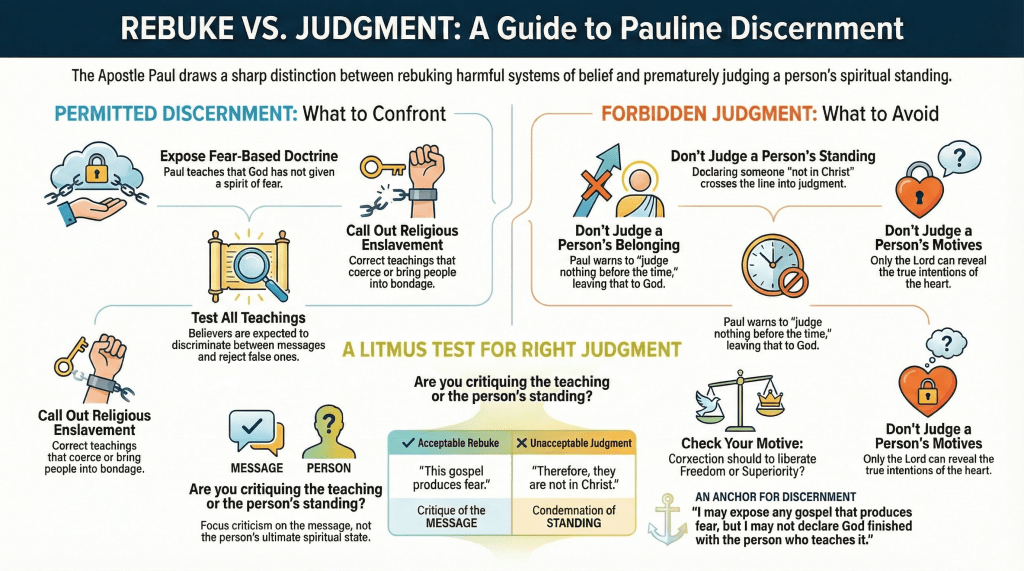
Rebuke vs. Judgment
(Paul makes a clear distinction)
Rebuking teaching ≠ judging persons
Paul constantly rebuked systems, messages, and distortions:
- “If anyone is evangelizing beside that which you accepted, let him be anathema” (Galatians 1:8–9)
- “I marvel that you are so quickly transferred…” (Galatians 1:6)
- “False brethren slipped in” (Galatians 2:4)
- “I do not commend you” (1 Corinthians 11:17)
Paul named error plainly.
But notice what he did not do:
- He did not declare believers “outside the Body”
- He did not deny Christ’s work in them
- He did not revoke their standing
So correction is not judgment, exclusion is.
What Paul forbids judging
Paul forbids judging:
❌ Standing
“Who are you to be judging another’s domestic?” (Romans 14:4)
❌ Belonging
“Judge nothing before the time” (1 Corinthians 4:5)
❌ Motives and designation
“The Lord… will manifest the counsels of the hearts” (1 Corinthians 4:5)
The moment we say: “They are not in the Body”
We cross from discernment into premature judgment.
What Paul commands discernment about
Paul expects you to:
✅ Expose fear-based doctrine
“God did not give us a spirit of fear” (2 Timothy 1:7)
✅ Test teachings
“Let the prophets be speaking… yet the others discriminate” (1 Corinthians 14:29)
✅ Reject coercion
“You were bought with a price; do not become slaves of men” (1 Corinthians 7:23)
✅ Call out religion that enslaves
“You are observing days… I am afraid for you” (Galatians 4:10–11)
So yes, calling out hellfire preaching, fear, threats, and coercion is not only allowed, it’s Pauline.
How to know if you’re judging poorly
(this is the key)
Here are six diagnostic questions you can ask yourself. These are very honest tests.
1. Am I critiquing the message, or the person’s standing?
- ✔ “This gospel produces fear and contradicts grace” → OK
- ❌ “Therefore they are not in Christ” → overreach
2. Am I leaving room for God’s timing?
Paul always leaves space for:
- growth
- correction
- unveiling
- later realization
If your conclusion locks someone permanently out, it’s judgment before the time.
3. Does my correction aim at freedom or superiority?
Paul corrects to liberate, not to win.
If the tone is:
- grief
- concern
- longing for clarity
you’re aligned.
If it shifts toward:
- contempt
- finality
- identity condemnation
pause.
4. Am I willing to say “not yet” instead of “not at all”?
This is huge.
Paul’s worldview is temporal, not binary:
- now / later
- firstfruits / after
- immature / mature
- blind / seeing
“Not yet realizing” is Pauline.
“Not included” is rarely Pauline.
5. How to confidently know you’re judging rightly
- You are not trying to condemn people
- You are targeting a message that produces fear
- You are defending the finished work of Christ
- You are wrestling against exclusion, not enforcing it
That will place you closer to Paul than to religious judges.
One refinement to consider (by moving this way):
“Aim your strongest language at systems, doctrines, and gospels, and your gentlest language at people and their standing.”
That’s exactly how Paul writes Galatians.
6. A Pauline sentence to keep as an anchor
A single internal rule:
“I may expose any gospel that produces fear, but I may not declare God finished with the person who teaches it.”
That keeps it bold and clean.
Where Careful Clarification Can Help
1. Person vs. Message distinction
In some parts language could sound like:
“Because someone teaches fear, hellfire, and condemnation, they themselves are not right with God.”
That might be inferred even if you don’t intend it.
Paul strongly rebukes false gospels, but he never declares a believer excluded from Christ simply because they preach error. He distinguishes message from belonging. (See 1 Corinthians 4:5; Romans 14:4.)
Suggestion:
I reject fear-based gospels because they distort the good news — but I do not declare that every person who teaches them is outside the Body of Christ.
This protects the messages from being read as judgmental rather than corrective, which aligns with Paul’s pattern.
2. Avoid implying motive equals exclusion
At times, lines about “fear replacing love” might be read as implying that anyone whose teaching produces fear is unregenerate. While true in effect, Paul would say the effect exposes error in teaching, not God’s verdict on the person’s eternal standing.
Gentle revision around this helps keep your article both true and charitable.
3. Making sure your strong language targets false teaching, not people’s salvation
Here’s a Pauline pattern that fits and avoids unintended judgment:
- Call out false teaching clearly
- Encourage people to embrace the true gospel
- Leave ultimate judgment to God, not us
This matches Paul’s own language when he attacks false apostles (Galatians 1) without pronouncing their eternal state.
🧭 How to Know You Are Judging Well vs. Poorly
Here are Paul-aligned markers you can use (derived from how Paul writes):
✔ You are judging messages, not souls
Example: “This teaching distorts the Gospel.”
Not: “That person is not in Christ.”
✔ You leave space for God’s timing and mercy
Example: “May God bring revelation and realization.”
Not: “This person is finished.”
✔ Your aim is restoration, not exclusion
Paul rebuked error with passion, but always with the goal of bringing hearts to truth, not dismissing them.
 Reconciliated Truths