
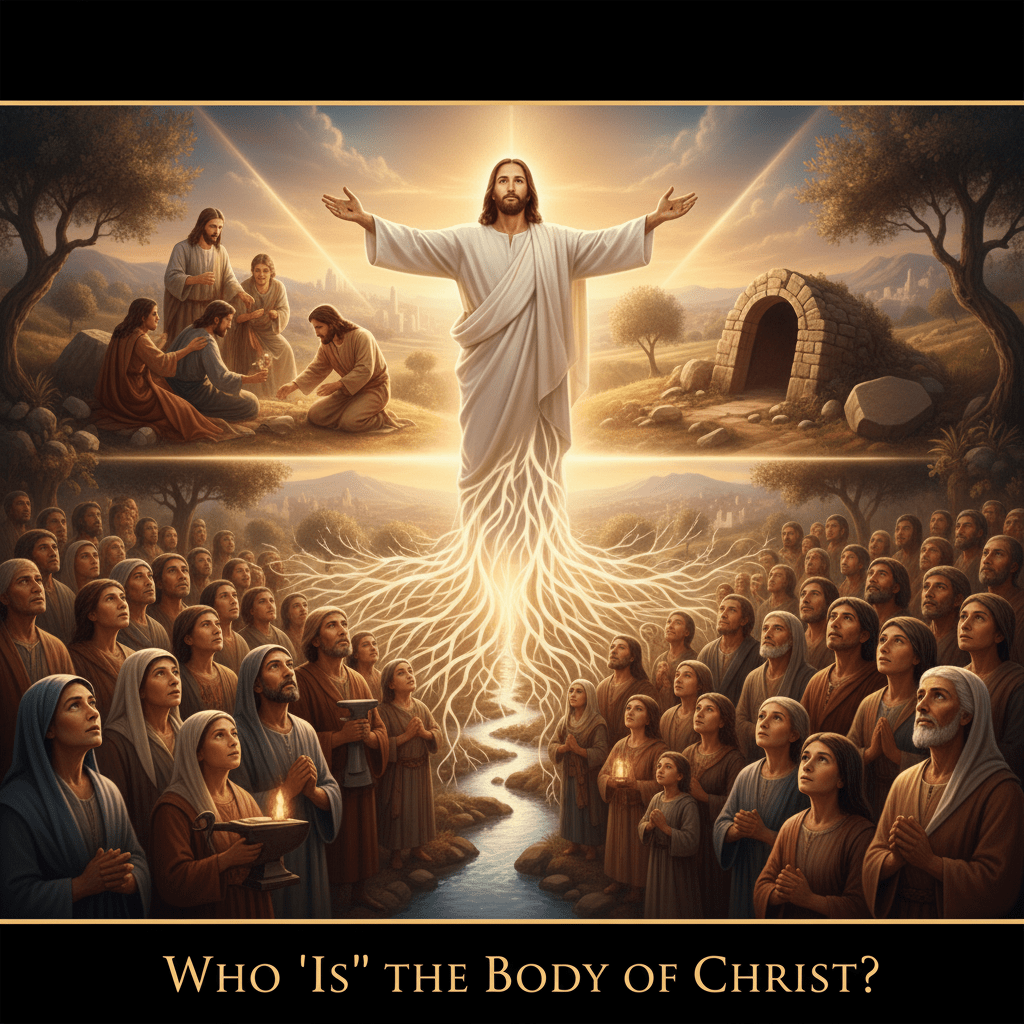
1. Inside the Body of Christ (first resurrection / snatching away)
1 Corinthians 4:5 (CLV)
“So that, judge nothing before the time, until the Lord should be coming, Who will also be bringing to light the hidden things of darkness and will be manifesting the counsels of the hearts. And then each will have praise coming to him from God.”
Who:
- Disciples (Circumcision / Kingdom-focused believers / Post-Jesus Resurrection)
- Paul-era Gentiles (Uncircumcision / Grace-focused evangel)
- Martyrs, living believers foreknown and called by God (Before the Tribulation / Affliction through Indignation)
What characterizes them spiritually:
| Characteristic | Explanation | Scripture |
|---|---|---|
| Union with Christ | They are truly “in Christ”; salvation depends on Christ’s faithfulness, not works | Ephesians 1:4–5, 2:8–10 |
| Faith that justifies | Disciples may emphasize works; Paul emphasizes grace; both rely on Christ | Galatians 2:16; James 2:22 (works show faith, not earn salvation) |
| Obedience as fruit | Obedience and works are the evidence of union, not the currency of salvation | John 14:15; Ephesians 2:10 |
| Not appointed to wrath | Foreknown, predestined, called to be spared from God’s indignation | 1 Thessalonians 5:9; Rom 8:29–30 |
| Death bypassed or defeated | Living believers transformed; dead believers resurrected | 1 Cor 15:51–52; 1 Thess 4:16–17 |
The starting point is not faith, belief, obedience, or doctrine. The starting point is God’s prior decision.
Ephesians 1:4–5, 11 (CLV)
“According as He chooses us in Him before the disruption of the world…
being designated beforehand according to the purpose of Him Who is operating all in accord with the counsel of His will.”
Therefore:
- No one enters the Body because they:
- believed correctly
- believed early
- believed Paul instead of the Twelve
- avoided works
- Belief itself is an outcome, not a cause
This removes the first Christian assumption.
What the Body of Christ actually is
(not what “churches” say it is)
The Body of Christ is not:
- a voluntary group
- a faith community
- a doctrinal alignment
- a reward for correct theology
The Body of Christ is:
- a pre-designated company
- created before time
- placed in Christ
- for a celestial purpose
1 Corinthians 12:18 (CLV)
“Yet now God places the members, each one of them, in the body, according as He wills.”
Placement is unilateral.
Why the disciples are in the Body
(without Christian reasoning)
Not because:
- they preached grace clearly
- they understood justification
- they avoided works
- they passed doctrinal exams
But because:
- they were foreknown
- they were given to the Son
- they were designated beforehand
John 17:6 (CLV)
“Yours they were, and to Me You give them.”
Paul does not redefine the Body later, he reveals its scope.
The disciples:
- had roles within Israel’s administration
- preached a Kingdom evangel
- misunderstood grace repeatedly
- argued with Paul
None of that matters.
Role ≠ Identity
Administration ≠ Placement
What about Judas Iscariot?
Judas is not in the Body of Christ, because he died before the resurrection of Jesus. Making him amongst the rest of Humanity appointed for the Great White Throne of Judgement.
Faith vs works – stripped of moralism
Disciples: Faith + Works
Paul: Faith apart from works
Christian error:
- treating this as a salvation divide
Pauline reality:
- treating this as an administrative distinction
Both groups:
- were sinners
- were locked in stubbornness
- were justified by Christ’s faithfulness
- were never righteous in themselves
Romans 3:22 (CLV)
“Yet a righteousness of God through Jesus Christ’s faith,for all, and on all who are believing.”
Faith is of Christ, not generated by the subject.
Who Is Outside the Body
(Before the Snatching)
A simple explanation:
First, who is NOT outside the Body?
People are not outside the Body because they:
- sin a lot or struggle repeatedly
- believe wrong things or misunderstand the Bible
- believe in hell or preach fear
- go to church or practice religion
None of these things decide who belongs to the Body of Christ.
So who is outside the Body?
Some people are outside the Body for now because:
- God did not choose them ahead of time for this present plan
- they are placed outside the Body on purpose, not by mistake
- they are part of a different resurrection and judgment order
This is God’s decision, not ours.
Romans 9:18 (CLV)
“Consequently, then, whom He wills, He is merciful to, yet whom He wills, He is hardening.”
What fear-based religion really shows
When someone teaches fear, hell, or punishment:
- it does not prove they are outside the Body
- it shows they have not yet realized their place in it
Fear shows immaturity, not exclusion.
Why this matters
If we say:
“People who preach hell or practice religion are not in the Body,”
Then belonging depends on:
- having the right beliefs
- speaking the right way
- learning truth at the right time
That turns grace into a rule system.
Paul’s gospel does not work like that.
The bold and true statement
Living in fear-based religion is strong evidence of not yet realizing one’s place in the Body, but it is not proof of not belonging to it.
God decides who belongs.
Understanding comes later.
That preserves:
- God’s sovereignty
- grace without condition
- progressive revelation
- your concern about fear-based systems
Without crossing into exclusion by doctrine. Those who persist in fear-based religion and preach hell and damnation generally do not manifest the consciousness or liberty of the Body of Christ.
This does not determine their designation, but reveals their lack of realization of it.
The snatching away (harpazō)
what it actually is
The snatching away is not:
- an escape reward
- a holiness prize
- a faithfulness bonus
- a reaction to belief
It is:
- the removal of a pre-chosen Body
- before a change in divine administration
- because that Body is not appointed to indignation
1 Thessalonians 5:9 (CLV)
“For God did not appoint us to indignation, but to the procuring of salvation through our Lord Jesus Christ.”
Appointment precedes experience.
Death itself is optional in God’s plan
Some:
- die and are resurrected
Others:
- never die
- are transformed
Why?
1 Corinthians 15:51 (CLV)
“Lo! I am telling you a secret: We shall not all be put to repose, yet we shall all be changed.”
Because death is not a moral necessity, but an administrative tool.
Summary
(no Christianity left)
The Body of Christ consists of those foreknown and designated beforehand in Christ before the world’s disruption; their belief, misunderstandings, works, sins, and roles are all operated outcomes, not conditions. The snatching away is the administrative removal of this Body prior to God’s indignation upon the earth, not a reward for faith or doctrine, but the execution of a prior divine decision.
That is Paul.
not Christianity.
2. Outside the Body of Christ
(remain in death until the Great White Throne)
Who:
- Jews who reject Christ or cling to law/works without faith in Christ
- Gentiles following false religions or worldly philosophies
- False Believers “Christians” (claiming Christ but rejecting His Grace or in union with Him. Who deny the power of God by limiting the scope of salvation, judgment, and God’s final victory over all.)
- Religions emphasizing fear, obligation, Coercion, or self-righteousness, & dissolution
Why Christians get this wrong
Christian theology:
- Makes belief the trigger
- Makes correct doctrine the qualifier
- Makes human response central
Paul:
- Makes foreknowledge the trigger
- Makes God’s counsel the qualifier
- Makes human belief the outcome, not the cause
Core differences / sins:
| Characteristic | Explanation | Scripture / Examples |
|---|---|---|
| Faith not united to Christ | They may believe in God, Jesus as figure, or morality, but do not trust in Christ’s faithfulness | John 3:18; Romans 10:9–10 |
| Reliance on works or ritual | Attempt to earn favor through law, works, tradition, or religious observances | Romans 3:20; Galatians 2:21 |
| Religion as control / fear | Preaching “hell, annihilation, eternal conscious torment, turn or burn, repent of sins” or threatening with judgment, rather than calling to Christ’s grace & the Father’s Love | Revelation 14:9–11 (false worship) |
| Focus on self or cycle | Hindu, Buddhist, or other religions emphasizing self-effort, reincarnation, karma, or dissolution | Romans 1:21–25 |
| Exclusion of mercy / grace | Islam, Judaism, Condemn others to death or eternal punishment for failing external standards | Matthew 23:13–15; James 2:19–20 |
| Not foreknown / called by God into union | Spiritually, they are outside God’s predetermined plan for the Body | Ephesians 1:4–5 |
3. Summary of the absolute difference
Inside the Body:
- Union with Christ; faith grounded in His faithfulness
- Works / obedience are evidence, not currency
- Not appointed to indignation / wrath; resurrected or snatched first
Outside the Body:
- No true union with Christ; faith is incomplete, misdirected, or works-based
- Rely on ritual, law, fear, or merit
- Remain subject to God’s judgment; resurrected later at Great White Throne
In short: the absolute dividing line is faith-union with Christ (Body membership), not mere religion, nationality, or works. All external religious participation, moral effort, or preaching of punishment cannot substitute for union with Christ, and that is why they are left out until the final resurrection and judgment at the Great White Throne.
4. “But the disciples believed in works + faith, why are they in the Body?”
- Answer: The Body of Christ is defined by union with Christ through faith, not by whether one emphasizes works as evidence of faith.
- The disciples’ teaching of faith + works does not disqualify them, because their works were fruit of their genuine faith, not the currency of salvation.
- Paul repeatedly distinguishes faith as the root of salvation from works as its evidence (Galatians 2:16; James 2:22).
- Therefore, although the disciples preached the Kingdom evangel emphasizing obedience, their personal trust in Christ united them to His Body, qualifying them for the first resurrection / snatching at the parousia.
In short: Faith + works as disciples understood it = fruit of union with Christ, not a barrier to Body membership. The disciples are in the Body of Christ because they were foreknown and designated beforehand in Christ, and their belief, misunderstanding, disputes, and works were all operated within that designation.
Pauline definition of the Body
- The Body of Christ is defined by union with Him through faith, not by which apostolic message one received (Ephesians 1:22–23; Romans 12:4–5).
- Paul’s concern in Galatians 1:6–9 is about distortion of the gospel, not about the disciples’ original Kingdom-focused evangel.
Disciples were personally united to Christ
- They believed in Christ, followed Him, and were foreknown and called by God (Acts 1:1–2, John 6:68–69).
- Faith + works as they understood it was not a distortion of grace, so they meet Paul’s criteria for Body membership.
Implications for resurrection
- Because they are in the Body of Christ:
- Dead disciples are raised among the first
- Those Living are transformed / snatched away at Christ’s parousia (1 Thessalonians 4:16–17; 1 Corinthians 15:23–52)
- Their Kingdom-focused message does not delay their participation in the first resurrection.
Summary
Paul never excluded the disciples from the Body of Christ; union with Christ through genuine faith, not the exact content of their ministry, determines Body membership, qualifying them for the first resurrection and snatching at parousia.
5. Union with Christ through personal faith
Paul defines Body membership as being in Christ, foreknown, called, and justified (Ephesians 1:4–5; Rom 8:29–30). For the disciples:
| Verse | Meaning / Application to Disciples |
|---|---|
| John 6:68–69 | Peter declares the disciples’ faith: “Lord, to whom shall we go? You have the words of eonian life. We have believed…” – this demonstrates personal union with Christ, the essence of being in His Body. |
| John 17:20–21 | Jesus prays for all who will believe through the disciples’ message to be one in Him, indicating that faith-union in Christ extends to them. |
| Acts 1:1–2 | Disciples are chosen, called, and taught by Christ personally – they are already foreknown and called by God. |
| 1 Corinthians 12:12–27 | The Body of Christ is one, many members; membership is based on faith-union, not ministry form – the disciples fit this definition through their faith in Christ. |
The disciples became members of the Body the moment they personally believed in Christ, not when Paul later clarified Gentile evangel doctrine. Their faith in Him automatically united them to the Body.
First Resurrection / Snatching confirms inclusion
- 1 Thessalonians 4:16–17; 1 Corinthians 15:23–52: Those in Christ (Jew or Gentile) are resurrected or transformed at parousia
- The disciples, already in union with Christ, are included in the firstfruits, which verifies their Body membership practically, not ceremonially
Final summary: Disciples and Paul’s Gentile Believers
Both the disciples and Paul’s Gentile believers were sinners – just like everyone else.
- They were not perfect, and they were not inherently righteous.
- Disciples emphasized faith + works; Paul emphasized faith by grace, but in neither case was righteousness their own.
- What made them righteous was Christ:
- Their sins were imputed to Him, and His perfect obedience was imputed to them (2 Corinthians 5:21).
- Their union with Christ is what reconciled them to God, not their works, knowledge, or heritage.
- They were the “sinners of reconciliation”:
- They came as sinners, unworthy, dependent entirely on God’s mercy.
- Christ transformed their status, made them righteous, and qualified them for the first resurrection / snatching away.
- Why this matters for doubters:
- Anyone claiming the disciples or Paul-era believers were righteous by nature or apart from Christ is misunderstanding salvation.
- Their inclusion in the Body of Christ and resurrection does not erase their sin nature, it reveals God’s grace in making sinners righteous through union with Christ.
The disciples and Paul’s Gentile believers were sinners just like everyone else, but in Christ, their sin was exchanged for His righteousness, proving that salvation and inclusion in the Body of Christ is entirely by God’s grace, not human merit.
6. Why God’s Administrations Do Not Determine Union in the Body
- Because union in Christ precedes and transcends administrations.
- Administrations govern roles and timing, not identity
In Paul’s framework, administrations (Israel, Body of Christ, Kingdom, Tribulation, etc.) are:
- how God operates in history
- when certain purposes unfold
- what roles people serve
They do not determine who is in Christ.
Ephesians 1:4 (CLV)
“He chooses us in Him before the disruption of the world.”
Union in Christ was decided before any administration existed.
Placement “in Christ” is pre-administrative
Paul never teaches that people are placed into Christ because of an administration.
He teaches the opposite:
Ephesians 1:11 (CLV)
“Being designated beforehand according to the purpose of Him Who is operating all…”
Administrations are tools God uses after placement, not gateways into placement.
Disciples and Paul’s believers differ in function, not union
- The disciples functioned under Israel’s Kingdom administration
- Paul’s believers function under the administration of grace
But:
- Function ≠ Union
- Role ≠ Identity
- Message emphasis ≠ placement in Christ
Both groups:
- were foreknown
- were designated beforehand
- were placed in Christ
- were sinners reconciled by Christ’s faithfulness
Administrations do not create multiple Bodies
Paul is explicit:
1 Corinthians 12:13 (CLV)
“For in one spirit also we all are baptized into one body…”
He never qualifies this by:
- covenant
- evangel type
- works emphasis
- Jewish or Gentile administration
There is one Body, not an Israel-Body and a Gentile-Body.
Why administrations cannot divide union
If administrations determined union, then:
- Christ would be divided
- foreknowledge would be reactive
- belief would precede designation
- God would be responding instead of operating
Paul rejects all of that.
Union is ontological (what you are in Christ).
Administrations are procedural (what God is doing through you).
Summary
God’s administrations do not determine union in the Body of Christ because union in Christ was decided before any administration existed; administrations govern roles, timing, and function in history, not identity in Christ. Therefore, both the disciples and Paul’s believers are in one Body by prior designation, even though they served under different administrations.
That is Pauline.
That is CLV-accurate.
That is not Christian system theology.
7. Disciples later believing Paul’s evangel (when? how so?)
The disciples did not initially believe Paul’s evangel.
They came into alignment with it after the revelation of the secret, when they recognized Paul’s apostleship, they ceased in opposing his message, and acknowledged that God was operating among the nations apart from the Law.
This alignment is recorded explicitly in Acts and confirmed in Paul’s letters.
The disciples originally preached a different evangel
Jesus’ disciples preached:
- repentance
- baptism
- Kingdom at hand
- Israel-first
- faith expressed through obedience
Matthew 10:5–7
“Go not off into a way of the nations… Yet go rather to the lost sheep of the house of Israel.”
That is not Paul’s evangel.
Paul receives a revelation the disciples did not have
Galatians 1:11–12 (CLV)
“The evangel which is being brought by me is not in accord with man… but through a revelation of Jesus Christ.”
This evangel includes:
- justification apart from Law
- reconciliation of the world
- the Body of Christ
- heavenly allotment
The disciples did not teach this before Paul.
The turning point: Jerusalem recognizes Paul’s evangel
Here is the moment that changed.
Galatians 2:7–9 (CLV)
“But, on the contrary, perceiving that I have been entrusted with the evangel of the Uncircumcision, according as Peter of the Circumcision…
James and Cephas and John… give to me and Barnabas the right hand of fellowship…”
This is not politeness.
This is recognition of divine administration.
They:
- acknowledge Paul’s evangel
- acknowledge God’s operation in him
- stop contesting it
They do not call it false.
They do not anathematize it.
They submit to its legitimacy.
That is alignment.
Peter explicitly affirms Paul’s message later
2 Peter 3:15–16
“Even as our beloved brother Paul, according to the wisdom given to him, writes to you…”
Peter:
- calls Paul “beloved brother”
- calls his message “wisdom given”
- warns others not to twist it
That is acceptance, not parallelism.
Disputes ≠ exclusion from the Body
Paul rebukes Peter (Galatians 2:11–14), but never declares him outside Christ.
Instead, Paul says:
1 Corinthians 12:13 (CLV)
“In one spirit we all are baptized into one body, whether Jews or Greeks…”
He does not exclude:
- the Twelve
- Jerusalem believers
- Peter
If they were not in the Body, Paul would be obligated to say so.
He never does.
What changed in the disciples?
They did not suddenly preach Paul’s evangel publicly.
But they ceased binding Law onto the nations, and they acknowledged:
- Gentiles are justified apart from Law
- God is operating a new calling
- Paul’s apostleship is from God
That is sufficient for Body inclusion.
Body membership is God’s operation, not doctrinal completeness.
8. Peter: God made no distinction & gave the spirit apart from Law
Acts 15:7–11 (CLV) = (Peter speaking publicly)
“Men, brethren, you are acquainted with the fact that from the early days God chooses among you that through my mouth the nations should hear the word of the evangel and believe.
And God, the Knower of hearts, testifies to them also, giving them the holy spirit even as to us,
and makes no distinction between us and them, cleansing their hearts by faith.
Now then, why are you testing God by placing a yoke on the neck of the disciples which neither our fathers nor we were able to bear?
But through the grace of the Lord Jesus we are believing to be saved, according to the same manner as those also.”
Key points (Peter):
- Nations believe without Law
- God makes no distinction
- Law is called a yoke
- Salvation is by grace, same for Jews & nations
This is a direct renunciation of binding the Law on Gentiles.
9. James: No Law imposed, only temporary concessions
James (head of Jerusalem assembly) confirms this officially.
Acts 15:19–20 (CLV)
“Wherefore I am judging not to be disturbing those from the nations who are turning to God,
but to write to them to abstain from the pollutions of idols and prostitution and what is strangled and blood.”
And again, critically:
Acts 15:28–29 (CLV)
“For it seems good to the holy spirit and to us to be placing no further burden on you, except these necessary things…”
Key points (James):
- “No further burden”
- Not Law-keeping
- Practical fellowship concerns only
- Explicitly not disturbing Gentiles
James is not smuggling Law back in.
He is addressing table-fellowship and cult practice, not salvation or righteousness.
“Pollutions of idols”
This refers to:
- meat used in idol temples
- cult meals tied to pagan worship
- ritual contamination
Paul later addresses the same issue in 1 Corinthians 8–10, making clear it is not sin in itself, but a matter of conscience and fellowship. So James is not teaching holiness law, he’s preventing idolatrous association that would fracture Jewish–Gentile assemblies.
“Prostitution” (πορνεία / porneia)
Here is where Christians usually go wrong.
In Second Temple Jewish usage, porneia often means:
- cultic sexual rites
- temple prostitution
- sexual acts bound to idol worship
Not:
- general sexual immorality as “Christian” later moral codes define it
This fits the phrase: “pollutions of idols and prostitution”
They belong together.
James is saying: “Do not participate in pagan temple rituals, which include sexual rites.“
This is cultic, not moral law.
“What is strangled”
This refers to:
- animals killed without draining blood
- meat prepared in pagan ritual contexts
For Jews, blood represented life (Genesis 9:4).
James is not declaring Gentiles sinners, he’s preventing ritual offense that would make shared meals impossible.
“And blood”
Same category as above.
- Not about salvation.
- Not about righteousness.
About:
- avoiding ritual defilement in Jewish conscience
- fellowship
- shared tables
Why these four specifically?
Because these were the four most common pagan temple practices Gentiles were coming out of:
| Practice | Issue |
|---|---|
| Idol food | Temple worship |
| Cult prostitution | Pagan rites |
| Strangled meat | Blood retained |
| Blood consumption | Ritual violation |
James’ goal:
“Do not bring pagan worship practices into mixed assemblies.”
Not:
“Keep the Law to be saved.”
Proof this is not Law re-imposition
James immediately says:
Acts 15:28 (CLV)
“to be placing no further burden on you…”
And later:
Acts 21:25 (CLV)
“we write, having judged to be observing nothing such, except to be guarding themselves…”
- Temporary.
- Practical.
- Not salvific.
When James tells Gentiles to abstain from idol pollution, prostitution, strangled meat, and blood, he is not imposing moral Law but instructing them to separate from pagan temple practices so that fellowship with Jewish believers would not be destroyed.
This keeps:
- administrations intact
- Paul intact
- James intact
- the Law intact
Why this mattered for early assemblies
Jewish believers:
- could not eat idol-meat knowingly
- could not fellowship with ritual impurity
- could not associate worship with sex or blood rites
Gentile believers:
- were leaving temple-religion
- but didn’t yet understand Jewish sensitivities
James’ ruling:
- “You don’t need the Law, but you must exit pagan religion.”
That’s the key.
Now, how does this map to Christianity today?
Here’s the important part…
10. Christianity is not exempt from becoming cultic
Christianity functions as a cultic system because it relies on:
- sacred buildings
- ritualized meals
- priestly mediation
- purity codes
- fear-based penalties
- symbolic blood emphasis
- moral performance for acceptance
At that point, it operates exactly like ancient religion, just with Christian language.
Modern “cultic” Christianity (parallels)
| Ancient Pagan Cult | Modern Christian Equivalent |
|---|---|
| Temple as sacred space | Church buildings |
| Priests as mediators | Clergy hierarchy |
| Sacred meals | Eucharist as requirement |
| Ritual purity | Behavioral holiness codes |
| Fear of divine wrath | Hell / judgment control |
| Blood sacrifice | Obsession with blood theology |
| Sexual control | Moral policing |
This is religion-as-system, not faith.
The distraught use of James “Faith without Works is dead”
The verse itself (context matters)
James 2:17 (CLV)
“Thus faith also, if it may not have works, is dead by itself.”
James is not defining how someone is justified before God.
He is addressing how faith is made visible and useful among people.
“Dead” does NOT mean “false” or “unsaving”
James does not say:
- faith is nonexistent
- faith is condemned
- faith fails before God
He says it is dead, meaning:
- inactive
- unproductive
- unexpressed
- ineffective in practice
A body can be dead and still be a body.
Faith can be real and still be functionally inert.
James is talking about demonstration, not justification
Key verse:
James 2:18 (CLV)
“Show me your faith apart from works, and I will show you my faith by my works.”
This is about:
- visibility
- credibility
- witness
- practical love
James’ question is not:
- “How is one made righteous before God?”
But:
- “What good is a faith that never acts in love?”
James’ examples prove the point
Example 1: The poor brother
- “If a brother or sister may be naked and lacking daily sustenance…”
Faith that only speaks but never acts:
- does not clothe
- does not feed
- does not help
That faith is “dead” to the situation, not dead before God.
Example 2: Abraham
James says Abraham was “justified by works” (James 2:21).
But when?
- After he already believed God (Genesis 15:6)
- Years later, when faith was expressed
So:
- Faith justified him before God
- Works justified (vindicated) his faith before others
Different courts. Different purposes.
Paul and James are NOT opposing each other
Paul speaks of:
- Justification before God
Romans 4:5 (CLV)
“To the one not working, yet believing… his faith is reckoned for righteousness.”
James speaks of:
- Faith’s usefulness among people
They answer different questions.
| Question | Answered by |
|---|---|
| How is one made righteous before God? | Paul |
| What does living faith look like? | James |
Why James had to say this (historical reason)
James is writing to:
- Jewish believers
- steeped in covenant life
- living in community
- responsible for care of others
A faith that:
- claims belief
- but withholds love
- fractures the community
That faith is “dead” relationally.
“Faith without works is dead” means that faith which never expresses itself in love is inactive and useless in practice, not that it fails to justify before God.
This keeps:
- Paul intact
- James intact
- Grace intact
- No works-salvation creep
Peter earlier: God cleanses Gentiles apart from Law
This is Peter recounting the Cornelius event.
Acts 11:17–18 (CLV)
“If, then, God gives them the equal gratuity as to us also, on believing on the Lord Jesus Christ, who was I that I should be able to hinder God?
Now, hearing these things, they quieted and glorified God, saying, ‘Consequently God gives repentance to life to the nations also!’”
No Law.
No circumcision.
No works added.
The disciples’ written decree confirms
Acts 15:24 (CLV)
“Since we hear that some went out from among us, disturbing you with words, unsettling your souls, saying you must be circumcised and keep the law, to whom we give no such injunction…”
This is decisive.
They explicitly say:
- Law-pushers did not come from them
- The disciples repudiate that teaching
The disciples ceased binding the Law upon the nations when Peter declared the Law a yoke not to be imposed (Acts 15:10–11 CLV), James ruled that Gentiles were not to be disturbed or burdened with it (Acts 15:19, 28 CLV), and the Jerusalem assembly formally denied authorizing circumcision or Law-keeping for Gentile believers (Acts 15:24 CLV).
The Final Answer
The disciples did not originally believe Paul’s evangel, but they later recognized it as God–given, ceased opposing it, and acknowledged Paul’s apostleship, placing them in alignment with the one Body formed by God through Christ after the resurrection.
No Christian synthesis.
No administration collapse.
No contradiction with CLV
 Reconciliated Truths